10 Frequently Asked Questions About Studying English in the Philippines — Answered Honestly
Thinking about studying English in the Philippines but not sure where to start? These are the questions we hear most often — answered directly, without the usual sales pitch.
Whether you’re just starting to research or already comparing schools, these are the most common questions we hear from students considering studying English in the Philippines — answered as directly as we can.
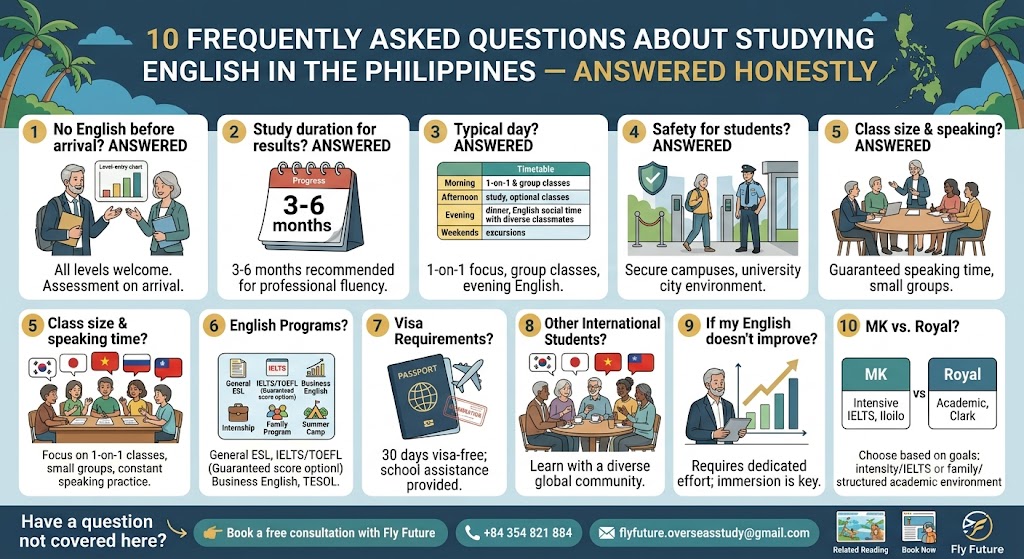
1. Do I need to speak English before I arrive?
No — and this is one of the most common misconceptions that stops people from enrolling.
English schools in the Philippines accept students at all levels, from true beginners to advanced learners looking to refine their fluency. Every new student goes through a level assessment on arrival, and your timetable is built around your current ability — not a fixed curriculum that assumes you’re already at a certain level.
That said, arriving with basic survival English (enough to understand simple instructions and introduce yourself) will make your first week noticeably less stressful. But it is not a requirement.
The level assessment on arrival ensures that studying English in the Philippines works for you regardless of where you start.
2. How long should I study to actually see results?
This is one of the most important questions when planning your time studying English in the Philippines.
Honestly? At least three months.
One month is enough to break the fear of speaking and see a measurable improvement in fluency — many students find this genuinely surprising. But the deeper changes — automatic grammar, natural rhythm, the ability to think in English rather than translate — take longer to develop.
Three months is the point at which most students report feeling genuinely different. Six months is when the transformation becomes difficult to ignore.
The reason the Philippines works so well is intensity: seven-plus hours of English every single day, inside and outside the classroom. The same number of study hours spread over two years of weekly classes back home doesn’t produce the same result. Immersion compresses the timeline.
If you can only commit to one month, go. You’ll come back for more.
3. What is a typical day like at an English school in the Philippines?
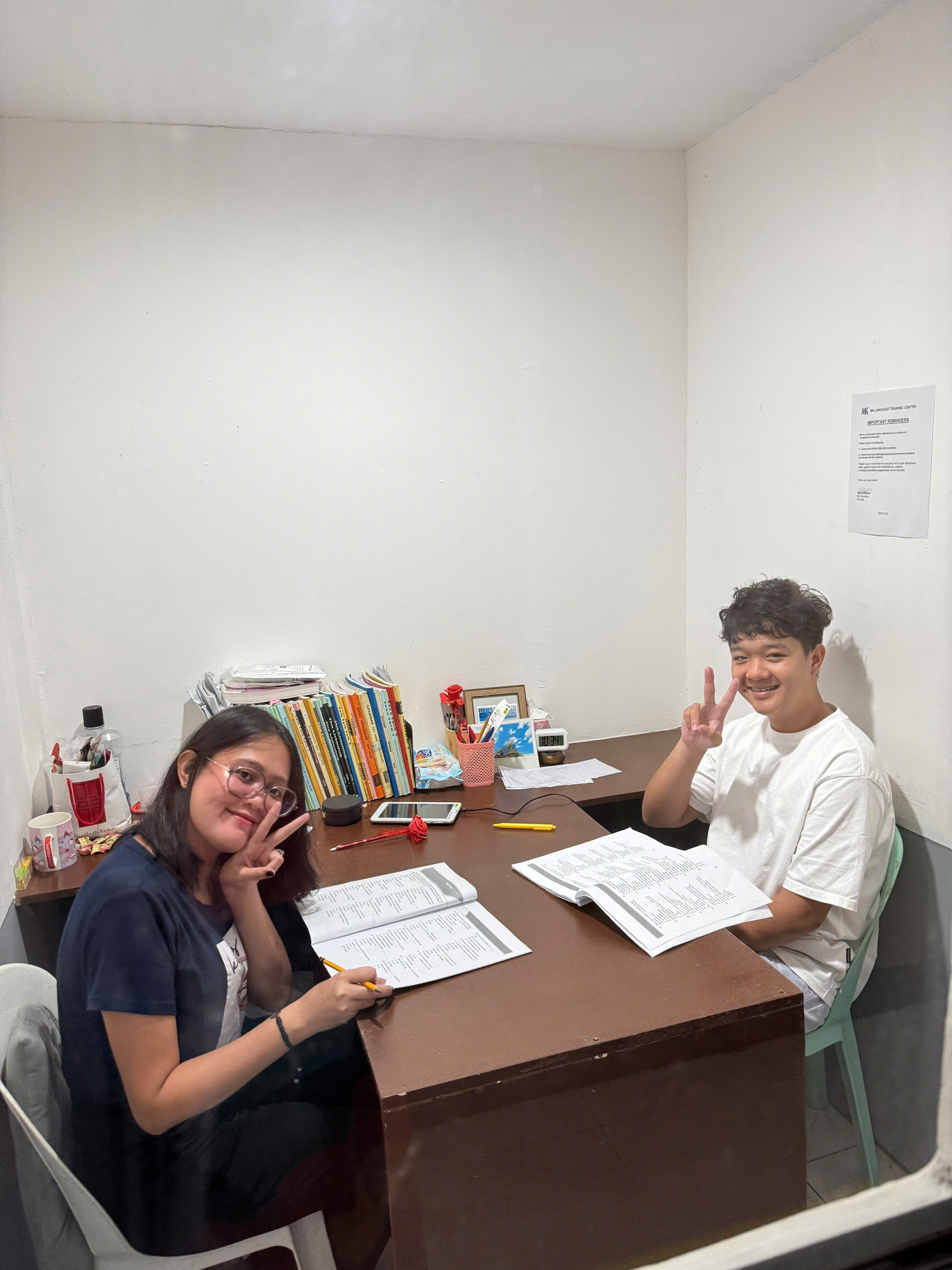
One of the things that surprises most students studying English in the Philippines is how structured and full the daily schedule is.
At MK Education in Iloilo City — one of the Philippines’ largest ESL centers — a typical student day looks something like this:
- Morning (first half): Two to three one-on-one classes with a dedicated Filipino teacher, covering speaking, grammar, pronunciation, or a specialist track (IELTS, Business English, etc.)
- Morning (second half): One to two group classes with international classmates — structured discussions, presentations, or skills-based activities
- Afternoon: Self-study sessions in the library or study rooms; optional additional classes; language lab time
- Evening: Informal English practice with classmates from Korea, Japan, Russia, Taiwan, and other countries — which turns out to be surprisingly effective
Meals are included and served on campus. Most students live in the school dormitory, which keeps you in an English environment around the clock — not just during class hours.
Weekends typically include optional organized excursions to nearby attractions, giving you a chance to practice English in real-world settings outside the campus.
4. Is it safe for international students?
Yes — the Philippines is one of the more welcoming countries in Southeast Asia for international students, and Iloilo City in particular has a well-established reputation as a safe, student-friendly environment.
A few practical points:
- On-campus accommodation at established schools includes 24-hour security. Living on campus is strongly recommended, especially for first-time visitors to the Philippines.
- Iloilo City is a university city with a large young population — it is walkable, low-key, and does not have the risks associated with major tourist hubs or capital cities.
- Standard precautions apply as they would anywhere: be aware of your surroundings, don’t leave valuables unattended, and use reputable transport.
Students from Russia, South Korea, Japan, Vietnam, and across Europe and Southeast Asia study in the Philippines regularly with no significant safety issues. The school’s duty-of-care includes airport transfers, orientation on arrival, and staff support throughout your stay.
5. What is the class size like? Will I actually get to speak?
This is one of the things that genuinely differentiates Philippines ESL from most other English study options.
The ratio of one-on-one to group classes at most Philippine academies is much higher than what you’d find in language schools in Western countries. At MK Education, a significant portion of your daily timetable is dedicated one-on-one time with a teacher — meaning hours of guided conversation practice focused entirely on your weaknesses and your goals.
Group classes are typically small (often 6–12 students), and the mix of nationalities means nobody has the option of reverting to their native language. A Russian, a Korean, a Japanese, and a Vietnamese student in the same classroom have one language in common.
Speaking practice is not something you have to seek out. It is simply what the day consists of.
This is one of the clearest advantages of studying English in the Philippines compared to language programs in Western countries.
6. What English programs are available?
Most established schools in the Philippines — including MK Education and Royal Academy (Fly Future’s two partner schools) — offer several distinct program tracks:
| Program Track | Core Focus & Content | Target Audience | Key Highlights & Notes |
| General ESL | Develops all 4 core skills: Speaking, Listening, Reading, and Writing from any proficiency level. | General learners looking to improve overall fluency and communication. | The most common and popular choice. |
| IELTS / TOEFL Prep | Structured specifically around exam formats, test-taking strategies, and score maximization. | Students needing official certificates for study abroad, immigration, or career growth. | MK Education offers a unique Guaranteed IELTS Program in Iloilo City (free tuition extension if the target score isn’t met). |
| Business English | Professional communication: meetings, presentations, negotiations, and workplace correspondence. | Working professionals and corporate employees. | Highly practical and tailored for career advancement. |
| TESOL / Teacher Training | Focuses on international English teaching methodologies and pedagogical skills. | Aspiring teachers who want to teach English professionally. | Professional certification track. |
| Internship Program | Combines academic English studies with real-world workplace experience. | University students or young professionals building a global resume. | Ideal for gaining international corporate exposure. |
| Family Program | Parents and children study in separate, age-appropriate classes on the same campus. | Families looking to improve their English skills together. | Available at Royal Academy; families stay together in the same dormitory room. |
| Summer Camp | Short-term format (typically 4 weeks) combining English classes with weekend excursions. | Young learners, juniors, and families during vacation periods. | High-engagement program focused on learning and travel. |
ELTS is administered globally by IDP and British Council — the same organizations that certify MK Education as an official test center.
The right program depends on your goal, your current level, and how long you can commit. Fly Future’s advisors can help you match these.
7. Do I need a visa to study in the Philippines?
Most nationalities — including citizens of Russia, Vietnam, South Korea, Japan, China, and most European countries — receive 30 days visa-free entry to the Philippines on arrival.
For programs longer than 30 days, you will need to extend your stay. This is a routine process that your school handles regularly. Key items:
- Visa extension: Applied for at the Bureau of Immigration; typically done monthly
- Special Study Permit (SSP): Required for foreign students attending language schools in the Philippines; your school will guide you through the application
- ACR I-Card: Required for stays longer than 59 days
Both MK Education and Royal Academy have experience supporting international students with immigration requirements. You will not need to navigate this alone.
Always verify the current requirements for your specific nationality before traveling, as visa policies can change.
For the most up-to-date entry requirements for your nationality, check the Philippines Bureau of Immigration official website.
8. Will I be the only international student? Who else studies there?
Students studying English in the Philippines come from over 10 countries in any given term.
Not even close.
The Philippines has been the destination of choice for English study among students from South Korea, Japan, and Taiwan for over two decades. More recently, students from Russia, Vietnam, China, and Southeast Asia have been enrolling in growing numbers.
At MK Education, the student body on any given term typically includes students from 10 or more countries. This matters more than it might seem: living and studying alongside people from Korea, Japan, Taiwan, Russia, and Vietnam means your informal English practice happens naturally, every day — in the dormitory, at mealtimes, on weekend trips — because English is the only language you all have in common.
Many students report that the international friendships they formed during their time in the Philippines were one of the most unexpected and lasting outcomes of the experience.
9. What happens if my English doesn’t improve?
The results you get from studying English in the Philippines depend almost entirely on what you do with your time.
This is a fair question, and the honest answer is: it depends almost entirely on what you do with your time.
Immersion works when you actually immerse yourself. Students who live on campus, attend all their classes, speak English with their classmates in the evenings, and push through the discomfort of the first few weeks consistently see strong results. Students who spend their evenings on their phones communicating only in their native language improve more slowly.
The school environment is set up to make immersion the default. But you have to meet it halfway.
For students enrolled in the Guaranteed IELTS Program at MK Education, there is a formal safety net: if you complete the program and don’t reach your target IELTS score (subject to attendance and initial level requirements), you can continue studying at no additional tuition cost until you do. This removes the financial risk of falling short by a band or two.
10. How do I choose between MK Education and Royal Academy?
Both are strong options for studying English in the Philippines. Here’s how to decide:
| MK Education (Iloilo City) | Royal Academy (Clark City) | |
|---|---|---|
| Best for | Intensive study, IELTS preparation, career-focused tracks | Structured academic environment, families |
| Unique feature | Guaranteed IELTS Program — only one in Iloilo | Family Program — parents and children study together |
| Community | Large international community (Korea, Japan, Taiwan, Vietnam, Russia, and more) | Smaller, more intimate setting |
| Programs | General ESL, IELTS, Business English, TESOL, Internship, Summer Camp, Family | General ESL, IELTS, TOEFL, Family (General & Schooling) |
| Location feel | University city; walkable, safe, student-friendly | Near Clark Freeport Zone; modern facilities |
If your primary goal is maximum intensity and the fastest possible English improvement, MK Education is generally the stronger fit. If you’re traveling with family or prefer a slightly smaller environment with academic structure, Royal Academy is worth considering.
Still not sure? Talk to Fly Future — we’ve placed students at both schools and can make a specific recommendation based on your profile and goals.
Have a question that isn’t covered here?
These are the ten we hear most often, but every student’s situation is different. If you’re wondering about something specific — your current English level, your country’s visa situation, which program fits your timeline, or how to make the most of your time in the Philippines — our team is happy to help.
👉 Book a free consultation with Fly Future
📞 +84 354 821 884
📧 [email protected]
Related reading: