How Much Does It Cost to Study English in the Philippines? A Complete Budget Guide for International Students
Wondering about the cost to study English in the Philippines? This 2026 guide breaks down tuition, accommodation, flights, visa, and daily expenses — plus a full comparison of MK Education vs Royal Academy.
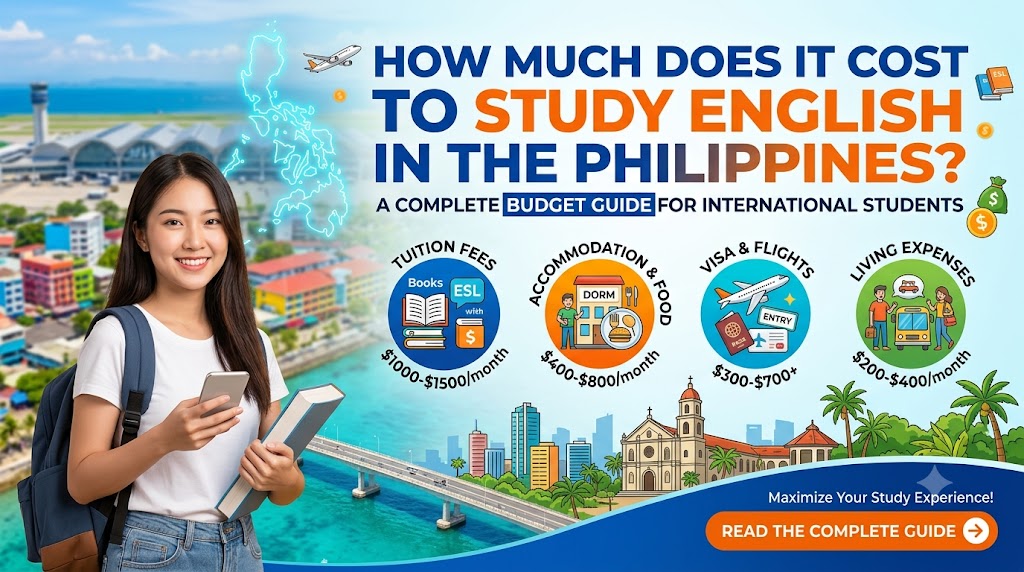
How much does it cost to studying English in the Philippines is one of the first questions every international student asks — and for good reason. Planning your budget carefully before you go means no surprises when you arrive. This guide breaks down every cost category involved in studying English in the Philippines: tuition, accommodation, flights, visa fees, and daily living expenses — so you can make an informed decision, wherever you’re coming from.
Why International Students Choose the Philippines for English Study
Students from Russia, South Korea, Japan, China, Taiwan, Vietnam, and across Southeast Asia and beyond have been choosing the Philippines as their English study destination for a simple reason: it delivers results at a cost that makes extended study genuinely feasible.
The cost to study English in the Philippines is significantly lower than comparable programs in Western countries — yet the quality of teaching and immersion environment is just as strong, if not stronger.
The Philippines offers:
- A fully English-speaking environment — English is an official language and used in daily life, not just in classrooms
- High-intensity study programs with significantly more 1-on-1 class time than equivalent programs in Western countries
- A warm, welcoming culture that helps international students settle in quickly
- Total costs that are a fraction of what you’d pay in the UK, Australia, the US, or Canada — without compromising on teaching quality
Whether you’re a student, a working professional, or a family looking for an immersive English experience, understanding the full cost picture before you go is essential. Here’s exactly what to plan for.
Understanding the full cost of studying English in the Philippines upfront is the best way to choose the right program length and school for your budget — and to avoid underestimating what you’ll need.
The 5 Cost Categories Every Student Needs to Plan For
1. 🎓 Tuition Fees
When calculating the cost of studying English in the Philippines, tuition is the largest and most variable component.
- Which school you attend — large, accredited academies with experienced faculty and modern facilities differ in pricing from smaller centers
- Which program you choose — General ESL, IELTS/TOEFL preparation, Business English, TESOL, Internship, and Family programs each have different structures and fee levels
- How long you study — most schools offer 4-week, 8-week, and 12-week packages; longer enrollments typically offer better value per week
- Class intensity — the ratio of 1-on-1 to group classes directly affects both tuition cost and learning outcomes
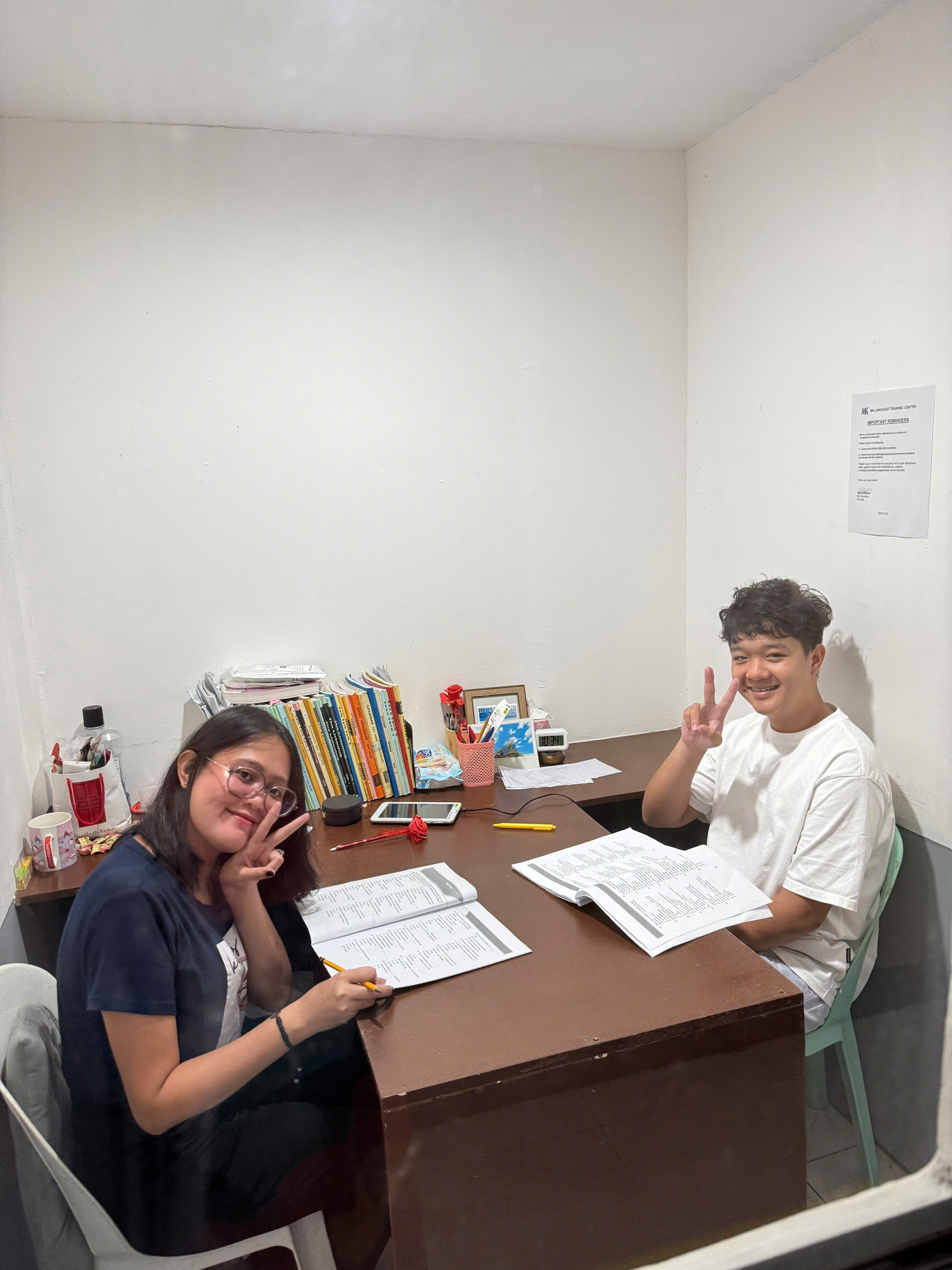
At MK Education (Iloilo City — one of the Philippines’ largest and most recognized ESL academies), tuition covers daily 1-on-1 classes, group classes with international peers, self-study sessions, learning materials, level assessments, and ongoing progress tracking. Notably, MK offers the only Guaranteed IELTS Program in Iloilo — if you don’t reach your target score, you continue studying at no additional tuition cost.
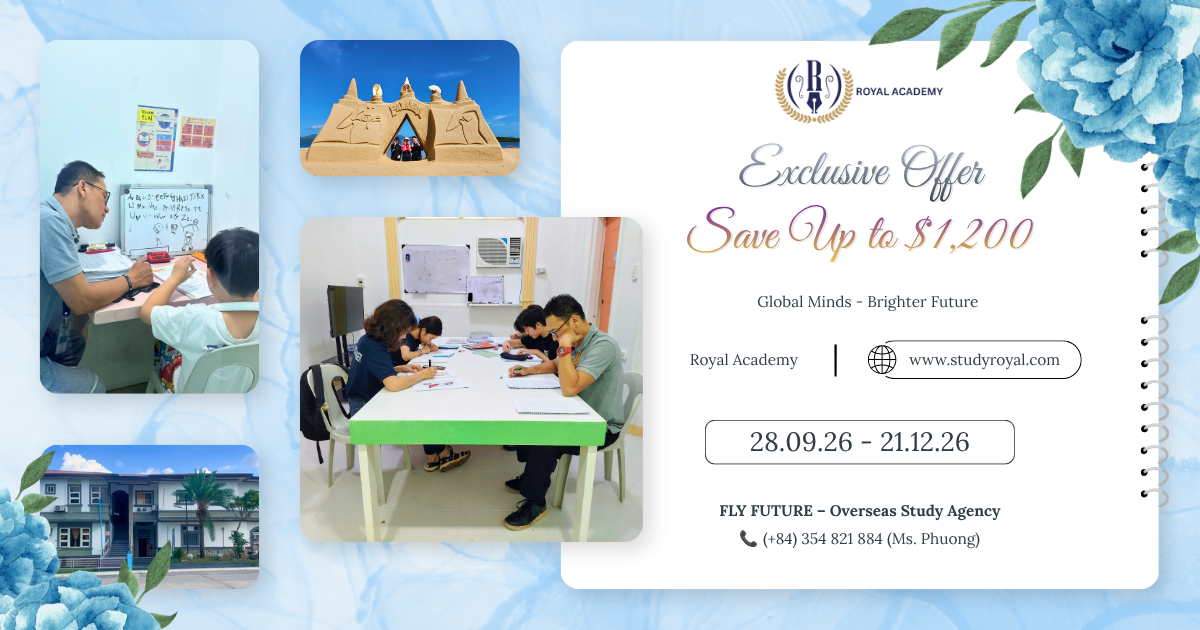
At Royal Academy (Clark City — affiliated with Angeles City College), tuition for the ESL program includes a structured combination of 1-on-1 and group classes, with a level-based curriculum from beginner through advanced. Royal also offers TOEFL and IELTS preparation tracks, as well as a unique Family Program that allows parents and children to study together on campus.
💡 Tuition costs vary by program, duration, and package. Contact Fly Future for a personalized fee breakdown based on your goals and timeline.
2. 🏠 Accommodation & Meals
One reason the cost of studying English in the Philippines is so competitive globally is accommodation. Unlike Western destinations where housing is a separate, expensive line item, most Philippine English academies bundle accommodation and meals directly into the program package…
On-campus dormitory accommodation typically includes:
- A shared or private room (your choice, at different price points)
- Three meals per day in the school cafeteria
- Utilities — electricity, water, Wi-Fi
- Access to facilities: library, gym, study rooms, common areas
- 24-hour security
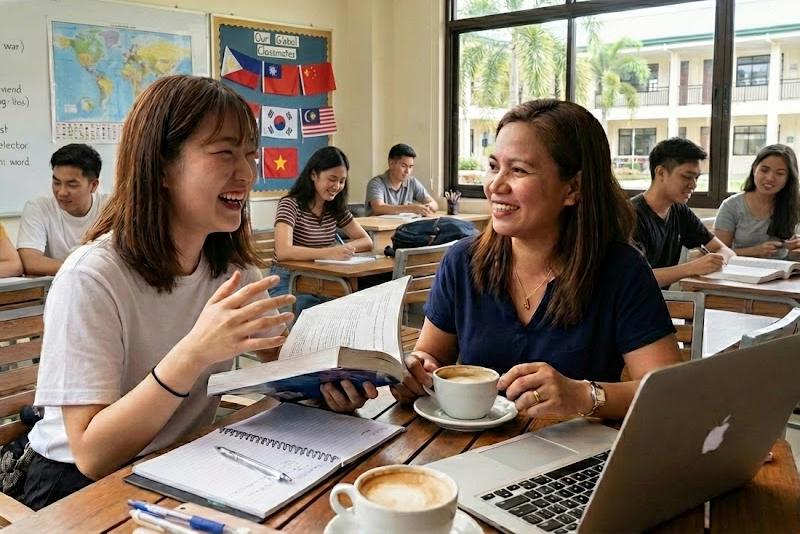
Living on campus is strongly recommended for international students — not just for cost reasons, but because full immersion (using English even outside of class hours, with classmates from Korea, Japan, Russia, Taiwan, and beyond) is one of the most powerful accelerators of English improvement. Students who live off-campus consistently report slower progress.
At Royal Academy, the Family Program takes this further: parents and children live together in the school dormitory, attend classes side by side, and practice English throughout the day — making it one of the few programs in the Philippines designed specifically for family-based immersion.
3. ✈️ Flights

The Philippines is well-connected internationally, with major hubs at Manila (Ninoy Aquino International Airport) and Cebu. From there, domestic connections reach Iloilo (for MK Education) and Clark/Angeles (for Royal Academy) easily.
Key factors affecting your airfare:
- Point of origin — flights from Northeast Asia (Korea, Japan, China, Russia’s Far East) and Southeast Asia are shorter and typically cheaper than from Europe or the Americas; students traveling from Russia or further afield should budget more for international legs
- How far in advance you book — booking 6–8 weeks ahead typically saves 30–40% compared to last-minute fares
- Season — June to August is peak season (higher demand, higher prices); January to March tends to offer the most affordable combination of flights and comfortable weather
Budget carriers (Cebu Pacific, AirAsia, and others) serve many regional routes. For students traveling from further afield, connecting through major Asian hubs (Singapore, Kuala Lumpur, Seoul, Tokyo) often offers the best combination of price and convenience.
4. 🛂 Visa & Immigration
Most nationalities — including citizens of Russia, Vietnam, South Korea, Japan, China, and much of Europe — receive 30 days visa-free entry to the Philippines on arrival. For longer study programs, visa extension is a routine process that established schools handle regularly.
Key immigration fees to plan for:
| Item | Notes |
|---|---|
| Visa extension | Payable at the Bureau of Immigration; typically extended monthly |
| Special Study Permit (SSP) | Required for foreign students studying at Philippine language schools; your school handles the process |
| ACR I-Card | Required for stays longer than 59 days |
Both MK Education and Royal Academy assist students with all immigration documentation as part of their student services — you will not be navigating this alone.
For a 3-month stay, budget approximately $100–200 USD in total visa-related fees, though this varies by nationality and length of stay.
Always verify current visa requirements for your specific nationality before traveling, as policies can change.
Visa and immigration fees are a small but important part of the overall cost to study English in the Philippines — especially for programs longer than 30 days.
5. 🍜 Daily Living & Personal Expenses
The Philippines — especially Iloilo City and Clark City — is genuinely affordable for day-to-day life. Since most meals are included in your school package, personal spending is largely discretionary.
Typical personal expenses per month:
- Extra food and drinks — a meal at a local restaurant costs roughly $2–5 USD; coffee shops and convenience stores are plentiful and cheap
- Weekend activities — the Philippines rewards exploration; popular student trips include island hopping, beach days, and visits to heritage sites; budget $20–50 USD per trip depending on distance
- Toiletries, laundry, SIM card — approximately $20–30 USD/month; local SIM cards with generous data plans are cheap and easy to buy at the airport on arrival
- Shopping — SM City Iloilo and SM Clark both offer international brands alongside local markets; spending here is entirely optional
A comfortable personal spending budget for most international students: $100–200 USD per month, depending on lifestyle and how much you explore on weekends.
Total Cost Overview: What to Expect
Rather than publishing fixed tuition numbers (which vary by program and are best discussed directly), here’s how the cost picture comes together:
| Category | 1 Month | 3 Months |
|---|---|---|
| Tuition + Accommodation + Meals | Contact Fly Future for pricing | Contact Fly Future for pricing |
| International Flights | Varies by origin; budget accordingly | Same (one-time cost) |
| Visa & Immigration | ~$0 (free 30-day entry) | ~$100–200 USD total |
| Personal Expenses | ~$100–200 USD | ~$300–600 USD |
When evaluating the cost to study English in the Philippines versus other destinations, the key differentiator is what that cost includes: full-day classes, housing, meals, and a 24/7 English environment — all bundled.
One important principle: the longer you stay, the better value you get — both financially (lower per-week cost on longer packages) and academically (English improvement is significantly stronger over 3 months than over 1 month). The fixed costs — flights and visa setup — are the same regardless of length, so students who can commit to a longer stay get disproportionately more out of their investment.
The cost to study English in the Philippines — when you factor in tuition, accommodation, meals, flights, visa, and personal spending — is typically a fraction of what an equivalent program in the UK, Australia, or the US would cost. For most international students, a 1-month program is achievable on a modest budget, while a 3-month commitment offers significantly better value per week and dramatically stronger language results.
MK Education vs. Royal Academy: Which Is Right for You?
Fly Future works directly with two of the Philippines’ leading English academies. Here’s how they compare:
| MK Education (Iloilo) | Royal Academy (Clark City) | |
|---|---|---|
| Strength | Largest ESL center in Iloilo; strong IELTS track record | Affiliated with Angeles City College; personalized and structured |
| Best for | Students wanting intensive study, IELTS prep, or career-focused programs (Business English, TESOL, Internship) | Students and families wanting a structured curriculum with academic affiliation |
| Unique feature | Guaranteed IELTS Program — free extended study until target score is achieved | Family Program — parents and children study on campus together |
| Community | Large international community (Korea, Japan, Taiwan, Vietnam, Russia and more) | Smaller, more intimate environment |
| Programs | ESL, IELTS, Business English, TESOL, Internship, Summer Camp, Working Holiday, Family | ESL, IELTS, TOEFL, Family (General & Schooling) |
MK Education is one of the most popular choices for students researching the cost to study English in the Philippines — offering transparent, all-inclusive packages that cover tuition, accommodation, and meals.
Royal Academy in Clark City is another strong option for those comparing the cost to study English in the Philippines, particularly for families or students seeking an academic-affiliated environment.
Not sure which fits your profile? Talk to Fly Future’s advisors — we’ll match you to the right school, program, and package based on your English level, nationality, goals, and timeline.
For students comparing destinations, the cost of studying English in the Philippines stands out not just for being affordable, but for what that cost includes: full-day instruction, on-campus housing, three meals a day, and a genuinely immersive English environment — all in one package.
5 Ways to Get the Most Value from Your Philippines Study Experience
1. Stay longer
A 3-month program gives you better per-week value than three separate 1-month enrollments, your English improvement will be dramatically greater, and the fixed costs (flights, visa setup) are spread across more learning days.
2. Choose on-campus accommodation
It’s cheaper, meals are included, and the immersion benefit is enormous. The informal English practice you get living alongside classmates from 10+ different countries is something no classroom can replicate.
3. Book flights early
This is one of the easiest ways to reduce your total budget. Locking in flights 6–8 weeks ahead of your start date consistently saves money compared to booking close to departure.
Flights are often the most unpredictable part of the total cost to study English in the Philippines, but booking early and traveling outside peak season can reduce this significantly.
4. Use the Guaranteed IELTS Program wisely
If IELTS is your goal and you’re enrolling at MK, the guaranteed program removes the financial risk of falling short and needing to pay for a repeat course elsewhere. It’s a meaningful differentiator worth factoring into your program choice.
5. Plan around January–March if possible
This window combines affordable flight prices, comfortable weather, and lower peak-season demand at schools — making it the most cost-efficient time of year to study in the Philippines.
Understanding the cost to study English in the Philippines is just the first step — how you structure your stay determines whether you get maximum value from that investment.
Comparing the Philippines to Other Study Destinations
To put the Philippines in perspective:
| Destination | Approx. Monthly Cost (Tuition + Accommodation) | English Environment | Visa Complexity |
|---|---|---|---|
| Philippines | Affordable — contact Fly Future for current rates | Native-level, full immersion | Simple; 30-day visa-free for most nationalities |
| United Kingdom | $2,500–4,000+ USD | Native | Student visa required |
| Australia | $2,500–4,000+ USD | Native | Student visa required |
| United States | $3,000–5,000+ USD | Native | F-1 visa required |
| Malta / Ireland | $2,000–3,500+ USD | Native | Varies by nationality |
The Philippines consistently delivers native-level English immersion at a total cost that makes 2–3 month programs accessible for students from a wide range of backgrounds — without compromising on teaching quality or class intensity.
Ready to Plan Your Program?
Every student’s situation is different, and the cost of studying English in the Philippines varies depending on your chosen school, program, and duration. Your English level, nationality, study goals, and timeline all affect which package is the best fit — and how to structure your budget efficiently.
Ready to get an exact breakdown of the cost to study English in the Philippines based on your chosen program and duration? Contact Fly Future for a free, personalized quote.
Fly Future’s international admissions team can help you:
- Choose between MK Education (Iloilo) and Royal Academy (Clark City) based on your goals
- Select the right program — ESL, IELTS/TOEFL, Business English, TESOL, Internship, or Family
- Get a full, transparent cost breakdown with no hidden fees
- Navigate flights, visa requirements, and pre-departure preparation specific to your nationality
- Stay supported throughout your time in the Philippines
👉 Contact Fly Future for a free consultation
📞 +84 562 545 555
📧 [email protected]
📍 44 Le Van Luong Street, Thanh Xuan, Hanoi, Vietnam
Related reading: